
The price of electronic cigarettes in France in 2022 depended on a stable regulatory framework, with no specific tax on vaping. Understanding this period requires clearly distinguishing between the cost of equipment, that of consumables, and the volume constraints imposed by European regulations transposed into French law.
Regulatory constraints on volumes and direct impact on cost per milliliter
In 2022, the French regulation stemming from the decree of May 19, 2016, imposed three technical ceilings that directly structured the pricing grid of nicotine e-liquids: nicotine capped at 20 mg/ml, nicotine bottles limited to 10 ml, and pre-filled tanks limited to 2 ml.
These volume restrictions have a mechanical effect on the unit price. Packaging a nicotine e-liquid in a 10 ml bottle costs proportionally more than a 50 ml or 100 ml format, due to packaging, compliant labeling, and the child safety cap required for each unit. Therefore, the vaper consuming nicotine paid a structural premium compared to those using large-format nicotine-free bases.
We also found a detailed analysis of the price of electronic cigarettes on Cyber Journalisme that confirmed this pricing segmentation between nicotine and non-nicotine formats.
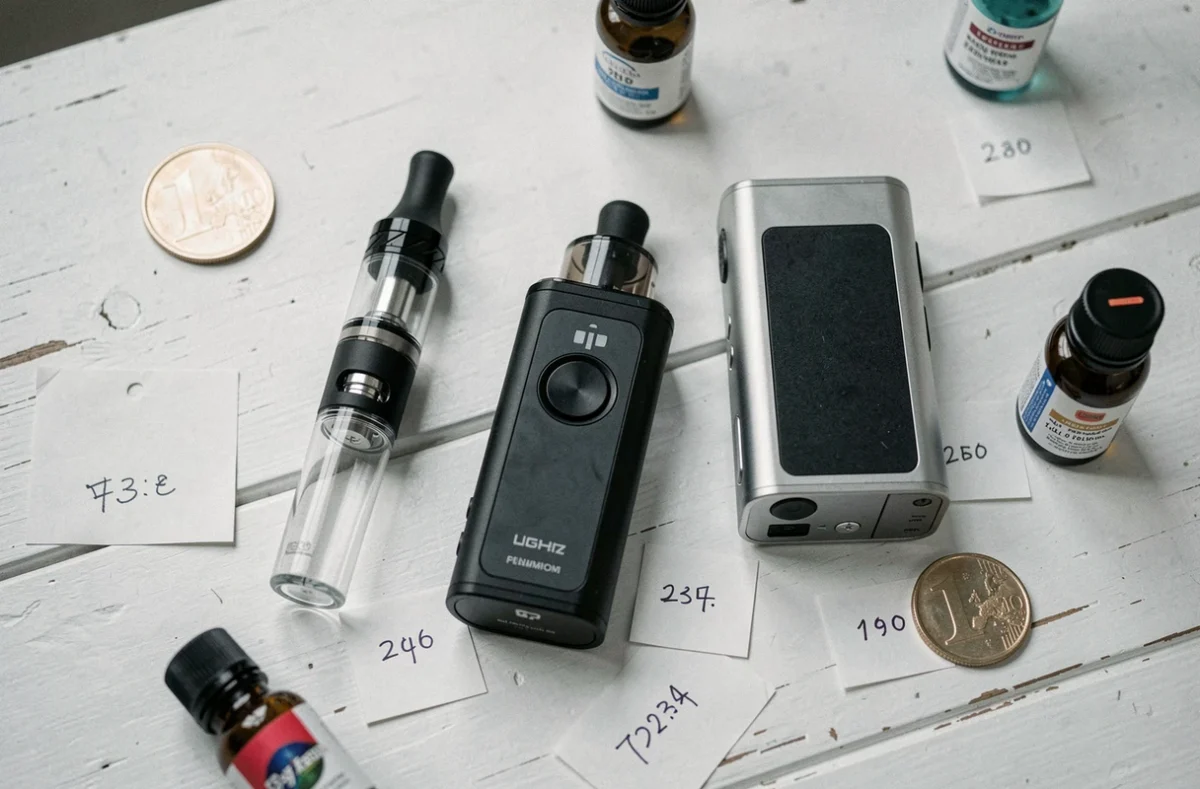
Large nicotine-free formats (shortfill) were already a common strategy in 2022 to reduce the cost per milliliter. A 50 ml bottle to which a 10 ml nicotine booster was added was significantly cheaper than purchasing six pre-dosed 10 ml bottles. The shortfill format was the main lever for cost reduction for regular vapers.
Price of electronic cigarettes in 2022: equipment versus consumables
Talking about the price of an electronic cigarette without separating the equipment from the consumables is like comparing a car to its fuel. In 2022, these two categories followed completely distinct pricing dynamics.
Rechargeable equipment: a one-time investment
The rechargeable device (box, pod, tube) represented a one-time purchase, renewed on average once or twice a year depending on usage. Entry-level ranges were in an accessible price range, while advanced models with power regulation and screens were significantly more expensive. The coils and replacement clearomizers were the only recurring expense on the equipment side.
Consumables: the real budget item
E-liquids represented the majority of a vaper’s annual budget. The frequency of renewal depended on the consumption profile:
- An occasional vaper consumed a few milliliters per week, keeping the monthly expense at a level much lower than that of a traditional tobacco smoker.
- A regular vaper, inhaling directly (DL), could consume several tens of milliliters per week, bringing the monthly budget closer to that of tobacco if e-liquids were exclusively purchased in small nicotine bottles.
- The use of DIY (do it yourself) bases allowed for a notable reduction in the cost of consumables, provided one mastered dosing and safety rules.
The annual expenditure on e-liquids varied from simple to fivefold depending on the mode of consumption and the choice of purchase format.
Absence of vaping tax in 2022: a favorable fiscal context
In 2022, no specific excise tax applied to vaping products in France. E-liquids were subject to VAT at the normal rate of 20%, like any other consumer good. This situation contrasted with several European countries that had introduced dedicated taxes.
The absence of specific taxation meant that the price variations observed in stores were primarily due to industrial and commercial factors: cost of raw materials (propylene glycol, vegetable glycerin, flavors), pricing policies of manufacturers, and positioning of specialized retailers.

This fiscal stability of 2022 takes on particular significance when compared to subsequent projects. The draft finance law for 2026 proposes a tax of a few cents per milliliter depending on the nicotine level, in addition to the existing VAT. The fiscal framework of 2022 thus represented the low point of the tax pressure on vaping products in France.
Evolution of the vape market in France: what changed in 2022
The year 2022 saw an acceleration in the diversification of flavors and ranges offered by French manufacturers. National brands expanded their catalogs, from classic tobacco flavors to fruity and gourmet flavors, without this diversification leading to a notable inflation in prices.
The market for puffs (disposable electronic cigarettes) experienced rapid growth that year. These single-use devices were sold at a low unit price, but the cost per milliliter vaped was significantly higher than that of a rechargeable device with bottled e-liquid. For a regular vaper, switching to puffs multiplied the budget compared to rechargeable.
On the public health side, French authorities maintained a cautious discourse, acknowledging the lower harm of vaping compared to smoked tobacco without making it an official cessation tool. This stance did not have a direct impact on prices, but it contributed to maintaining a stable regulatory framework, without new restrictions likely to increase product costs.
The price stability of 2022 can ultimately be explained by the conjunction of three factors: a fiscal framework without dedicated excise, active competition among manufacturers and distributors in the French market, and unchanged regulatory constraints since the transposition of the European directive. For vapers who had optimized their purchasing methods (shortfill, DIY, durable equipment), the annual cost remained a fraction of the equivalent tobacco expenditure.