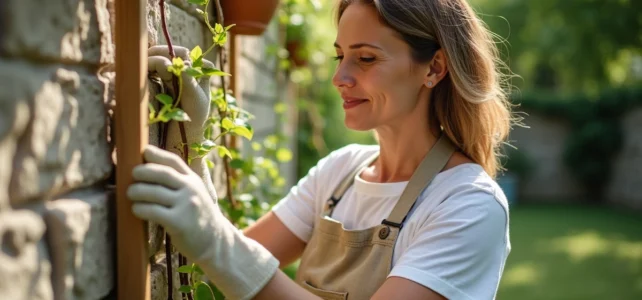
A star jasmine planted at the foot of a wall, which refuses to climb and spreads out on the ground like a ground cover: this situation is encountered in the majority of failed installations. The trachelospermum jasminoides does not climb on its own. Without guidance or suitable support, its flexible stems droop and the plant vegetates horizontally. Understanding this mechanism changes the way to approach training from the moment of planting.
Soil overheating in pots: the cause of failure that watering does not solve
On the rooftop terraces of Bordeaux and Toulouse, professional diagnostics have revealed that the mortality of young potted star jasmines is often related to substrate overheating rather than a lack of water. Dark pots, of small volume, exposed to full south turn the root ball into a steam bath.
There is a tendency to compensate by watering more, which drowns the roots in a burning substrate. The problem is not water-related; it is thermal. Choosing a light and large pot reduces root temperature much more effectively than additional watering.
If you are looking to find out how to make a star jasmine climb in a pot on a balcony or terrace, start by addressing this container issue before even thinking about support. A terracotta or light resin pot, at least 40 cm deep, protects the root ball during summer heat spikes.
For installations in troughs on concrete slabs, inserting an insulating plate (cork, extruded polystyrene) between the trough and the ground further limits temperature rise by conduction.
Training the star jasmine: taut cables versus rigid trellis
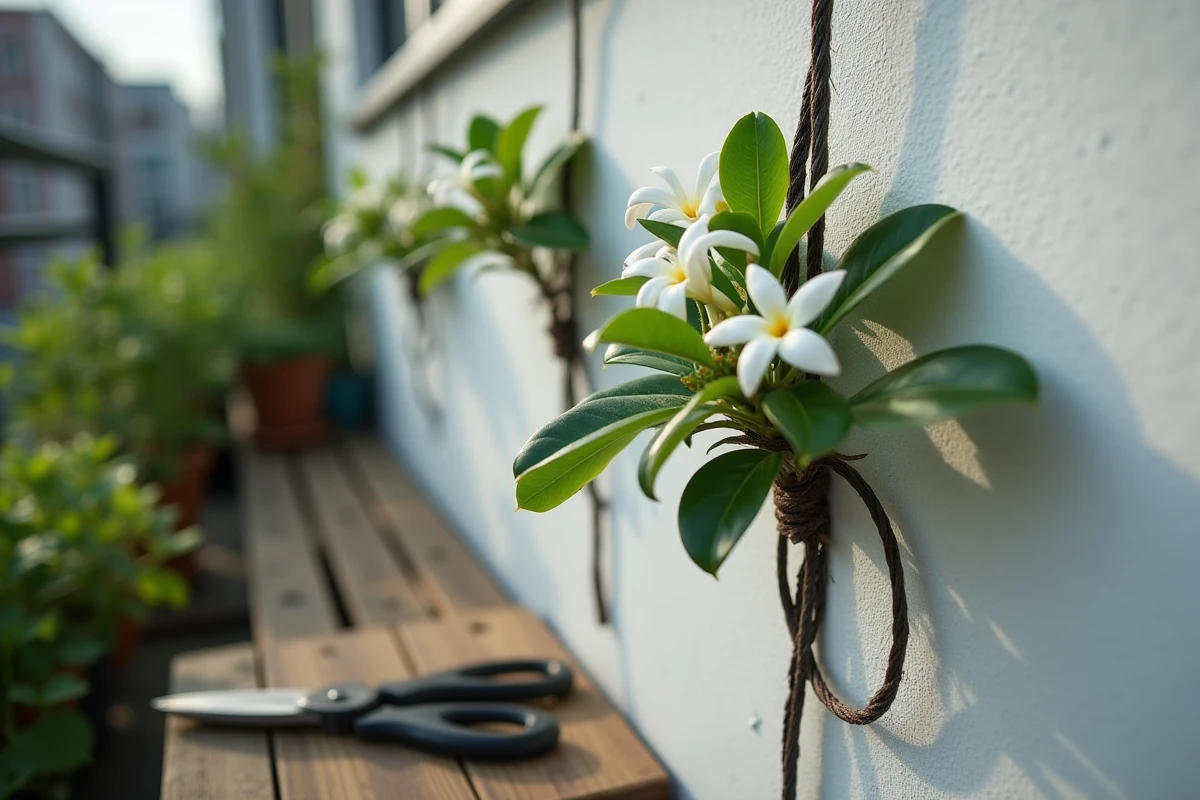
The trachelospermum clings by winding its stems, not by suckers or hooks like ivy. This distinction conditions the choice of support.
Fine mesh trellis or horizontal cables
A wooden or metal trellis with mesh sizes of 10 to 20 cm works well for the first few years: the young stems easily find a grip. The problem arises after three or four seasons when the plant mass becomes heavy. A trellis that is too light ends up being pulled off the wall under the weight of the foliage.
Horizontally tensioned stainless steel cables, spaced about twenty centimeters apart, offer a more durable alternative. Fixed by anchors sealed into the wall, they support a much greater load and allow for precise guidance of the growth direction.
The guiding gesture in the first months
During the first year, the main stems are attached to the support with soft ties (raffia, jute twine, rubber ties). A common mistake is to tighten too much or to use wire that cuts into the bark as it thickens.
- Fix the stems every 20 to 30 cm, leaving some slack for thickness growth
- Orient two or three main stems in a fan shape rather than letting them grow in a vertical bundle
- Remove low lateral shoots that pull the plant down during the first two years
- Check the ties every two months and loosen them if they mark the bark
Once the plant has colonized the first meter of support, its stems will wind around the cables or mesh on their own. Manual guidance then becomes occasional.
Exposure and south-facing wall: the trap of reflected heat
The star jasmine is often presented as a full sun plant, and this is generally true. However, a south-facing wall in an urban environment poses a specific problem: thermal reflection.
Comparative studies conducted by INRAE and VetAgro Sup on ornamental climbing plants in urban climates show that light shading on a south-facing wall maintains better flowering. A temporary shading cloth or simply shifting the planting to a southeast or southwest-facing wall is enough to correct the problem.
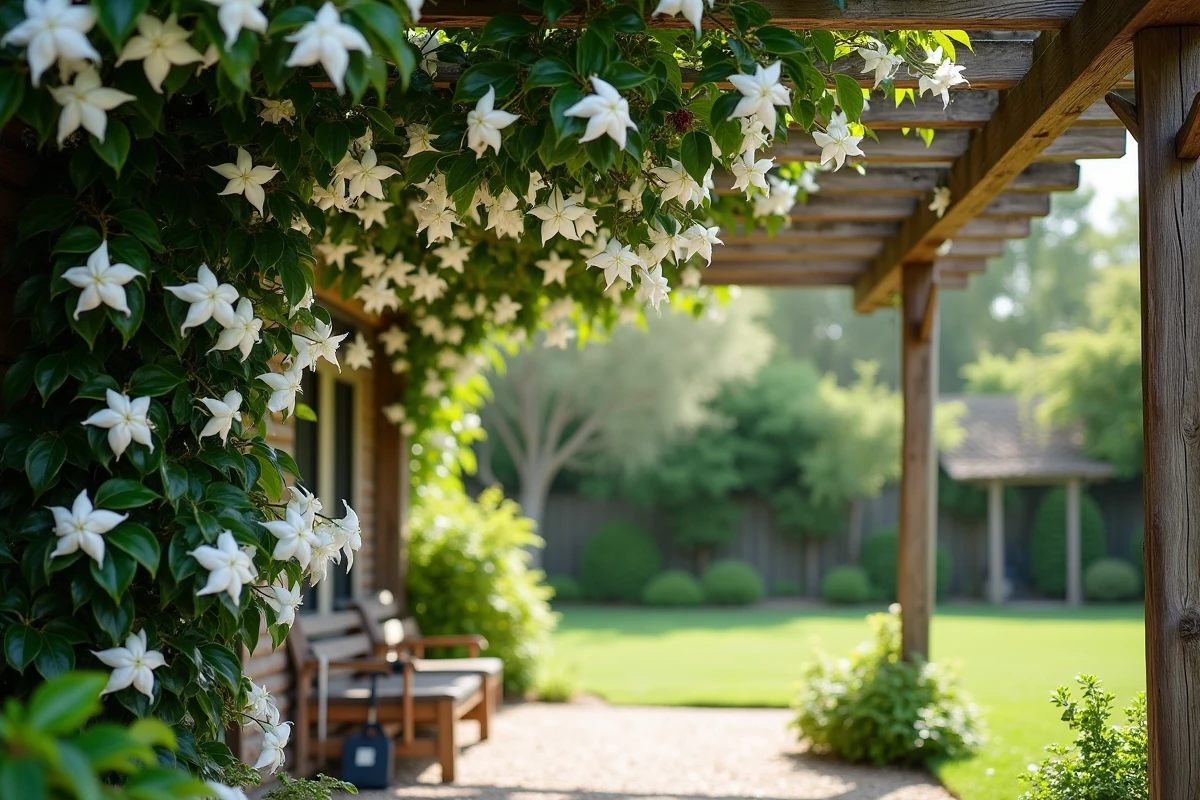
In practice, a white stone or light plaster wall reflects less than a dark cinder block wall. If the orientation cannot be changed, the color of the wall is an underestimated lever. A light wall behind the jasmine reduces leaf thermal stress without sacrificing brightness.
Star jasmine on facades and fences: a less aggressive alternative than ivy
Several French municipalities, including the City of Paris in its updated 2023 guide “Vegetalize Your Building,” now recommend trachelospermum over Virginia creeper or ivy for greening walls and fences. The reason is structural: the star jasmine does not damage plaster or joints since it winds instead of clinging with hooks.
This characteristic makes it a relevant choice for walls in good condition that one wants to green without risking degradation. On a wire fence, the result is quick: the mesh serves directly as support and the evergreen foliage forms a visual screen all year round.
Feedback varies on the speed of coverage depending on the regions, but generally, a standard fence panel sees adequate coverage in two to three growing seasons, provided the soil is well-draining and planting occurs in spring.
Soil and fertilizers: what truly accelerates growth
The star jasmine accepts most soils, including calcareous ones. What hinders its vertical growth is rarely the pH but rather compacted or waterlogged soil in winter.
- A well-draining soil remains the most determining condition: add gravel or coarse sand to the bottom of the planting hole if the soil is clayey
- A supply of mature compost in spring stimulates vegetative growth without burning the roots
- An organic fertilizer rich in potash (like tomato fertilizer) promotes flowering rather than just foliage
Fertilization and growth are often confused. An over-fertilized star jasmine with nitrogen produces many low leaves but climbs little. Reducing nitrogen in favor of potash directs energy towards flowering and elongation of stems.
The ideal planting period remains spring, after the last frosts. An autumn planting works in mild climates (Atlantic coast, Mediterranean rim), but recovery will be slower and the risk of root frost in pots exists in regions with harsh winters.
The star jasmine does not need exceptional conditions to climb. A solid support, a suitable pot if in a container, a corrected exposure if the wall is too exposed: these three parameters resolve the majority of failures encountered in the field.