The majority of Eastpak backpacks no longer come from the United States, contrary to a persistent belief. Their manufacturing now spans from East Asia to Eastern Europe, with some limited editions produced in France. This geographical distribution responds to economic imperatives but raises questions about traceability and sustainability.
The choice of production sites influences not only the perceived quality of the products but also the brand’s environmental and social commitment. Understanding this industrial organization reveals decisive criteria for evaluating the reliability and longevity of Eastpak backpacks.
Eastpak: An Iconic Brand Between Heritage and Commitment
The history and origin of the Eastpak brand span decades without losing relevance. Originally a supplier of sturdy luggage for the U.S. Army, Eastpak has carved out a prominent place in the urban landscape. Its recipe? A mix of authenticity, functionality, and bold graphics. Nothing has been left to chance: the brand has built its reputation on reliability, durability, and a constant ability to innovate.
What sets Eastpak apart is its way of blending heritage with innovation. The Eastpak bag has established itself as a daily ally, whether one is a student, traveler, or a professional on the go. The brand relies on proven design, materials selected for their durability, and a diversity of styles that evolve without ever breaking with its origins.
But behind each model, there is also a promise. Eastpak offers up to thirty years of warranty on its bags: a rare commitment that raises questions at a time when production has, in part, left its historical cradle. To keep its word, the brand relies on strict quality controls and increased transparency regarding its manufacturing locations. Today, those who buy an Eastpak bag want to know where and how it was made. This is not just a detail: the question of manufacturing reveals the brand’s values and highlights the evolution of industry expectations.
Where Are Eastpak Backpacks Actually Made and Why Origin Matters
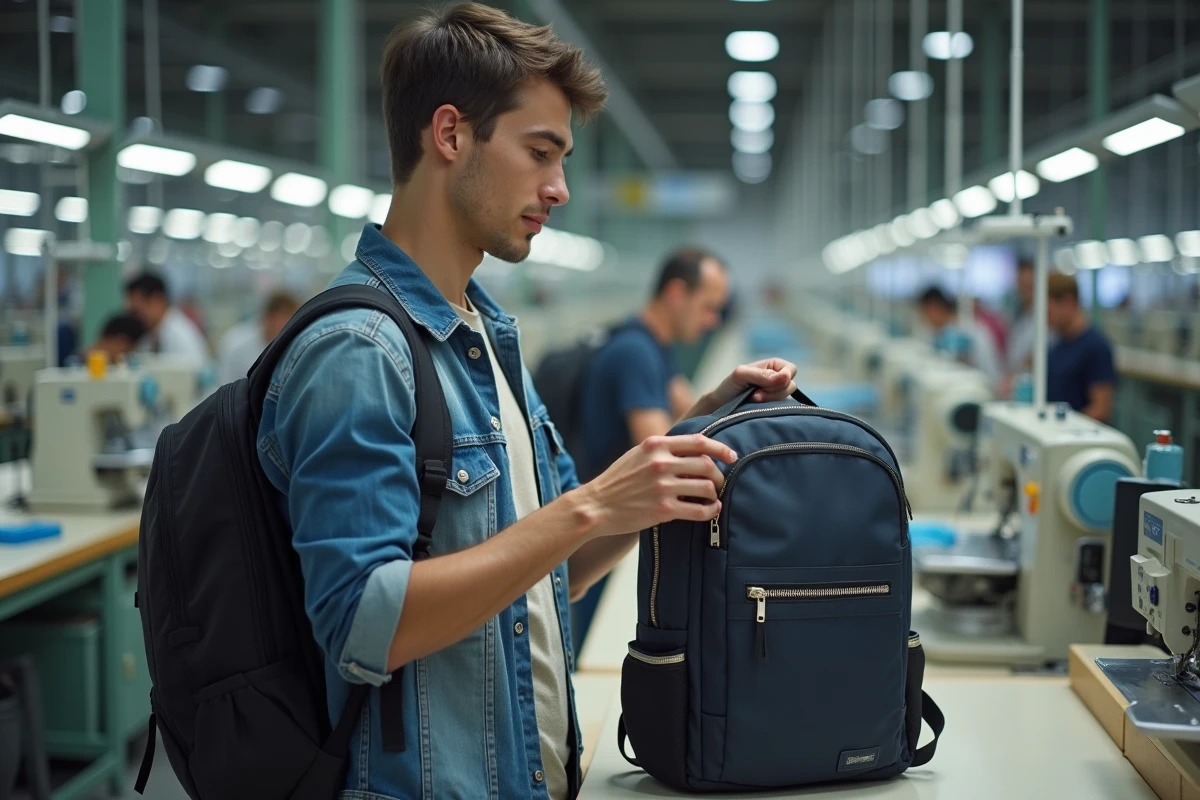
The workshops that manufacture Eastpak backpacks are no longer located on American soil. For some time now, the main production has shifted to Asia, particularly Vietnam and China. This reorganization allows for competitive pricing without compromising quality. Partner factories master textile manufacturing, with quality control that leaves nothing to chance.
The place of manufacture is not neutral: it is a criterion of trust, a question of traceability, and sometimes an ethical choice. When one wants to know where Eastpak backpacks are made, one discovers an industrial strategy that juggles between logistical optimization and a desire for transparency. The most discerning consumers examine the labels, hoping to find a model made in France or from a French leather workshop. However, the “Made in France” range is becoming rare. Only a few limited edition pieces are produced in workshops renowned for their craftsmanship.
| Place of Manufacture | Type of Bags Concerned |
|---|---|
| Vietnam, China | Main Range |
| France | Limited Editions, “Made in France” Models |
The choice of manufacturing location affects the shopping experience. Between the assurance of a bag designed to last, the extended warranty, and the pursuit of responsible production, every criterion counts. Manufacturing is no longer just a simple sequence of industrial steps: it becomes a key factor of trust for discerning buyers.

Sustainability, Guarantees, and French Manufacturing: What Really Sets Eastpak Bags Apart
At Eastpak, the notion of sustainability translates concretely: the brand offers up to thirty years of warranty on several models. This is not an empty promise. This longevity is based on specific choices: durable fabrics, reinforced seams, proven closures. Every step of manufacturing is designed so that the bag withstands the test of time, use after use. This stance shapes the relationship between the object and its owner.
Some ” made in France bag” models, such as the made france jack, the made france jules, or the made france paul, reflect another ambition. Produced in limited series in French leather workshops, they embody the demand for local craftsmanship and attention to detail. While French production remains marginal, each bag from these workshops tells a unique story: choice of materials, precise finishes, meticulous control.
Here is what characterizes Eastpak’s approach to quality and commitment:
- Long-term Warranty
- Manufacturing in specialized workshops
- Limited “made france” editions
For those looking for a travel bag, a fanny pack, or a laptop case, origin becomes a selection criterion. Connoisseurs can recognize the difference of a bag made in France: sharp cut, pleasant fabric, impeccable finishes. At Eastpak, the warranty goes beyond repair: it is a true commitment, from the selection of raw materials to the presentation in stores, whether in the city center or at Saint-Lazare, where the bags are showcased.
On the label of an Eastpak bag, there is more than just a country of manufacture. There is the story of an object designed to last, to traverse the years, and to carry, over the kilometers, the mark of those who chose it.