
The rail sector is undergoing a major transformation thanks to the energy transition. Rail professions are evolving to meet environmental and technological demands. Engineers are working on more eco-friendly trains, while technicians are training in new propulsion technologies, such as hydrogen and electricity.
Train drivers and maintenance staff are also adapting their skills to new realities. This evolution represents a challenge, but also an opportunity for young generations to embark on innovative and sustainable careers. The rail industry is positioning itself as a key player in green mobility.
Rail professions in full transformation
The rail sector, at the heart of the energy transition, is seeing its professions profoundly transformed. The company Alstom, a key player in this transformation, illustrates this evolution with its site in Creusot. Each year, nearly 2,000 bogies are produced there, forming the backbone of rolling stock.
Engineers and technicians: at the crossroads of innovation
Engineers are on the front line designing more eco-friendly trains. They integrate advanced propulsion technologies, such as hydrogen or electricity. Technicians, for their part, are training in the latest innovations:
- Use of welding robots, the most efficient in the rail industry.
- Predictive maintenance using tools from Industry 4.0.
The role of train drivers and maintenance staff
Train drivers and maintenance staff are also seeing their skills evolve. Training now incorporates new technological and environmental realities. The association Futur en Train, established in 2015, plays a fundamental role in promoting these developments among industry professionals.
The role of wagonists being redefined
The profession of wagonist is also being redefined. Civil engineering experts and design offices are working together to secure the rail network and integrate more sustainable infrastructures. In this regard, renovation and modernization projects are becoming cornerstones of ecological and energy transition.
These changes offer unprecedented opportunities for young generations. The rail industry is thus positioning itself as a sector of the future, aligned with the imperatives of reducing greenhouse gas emissions and sustainable development. 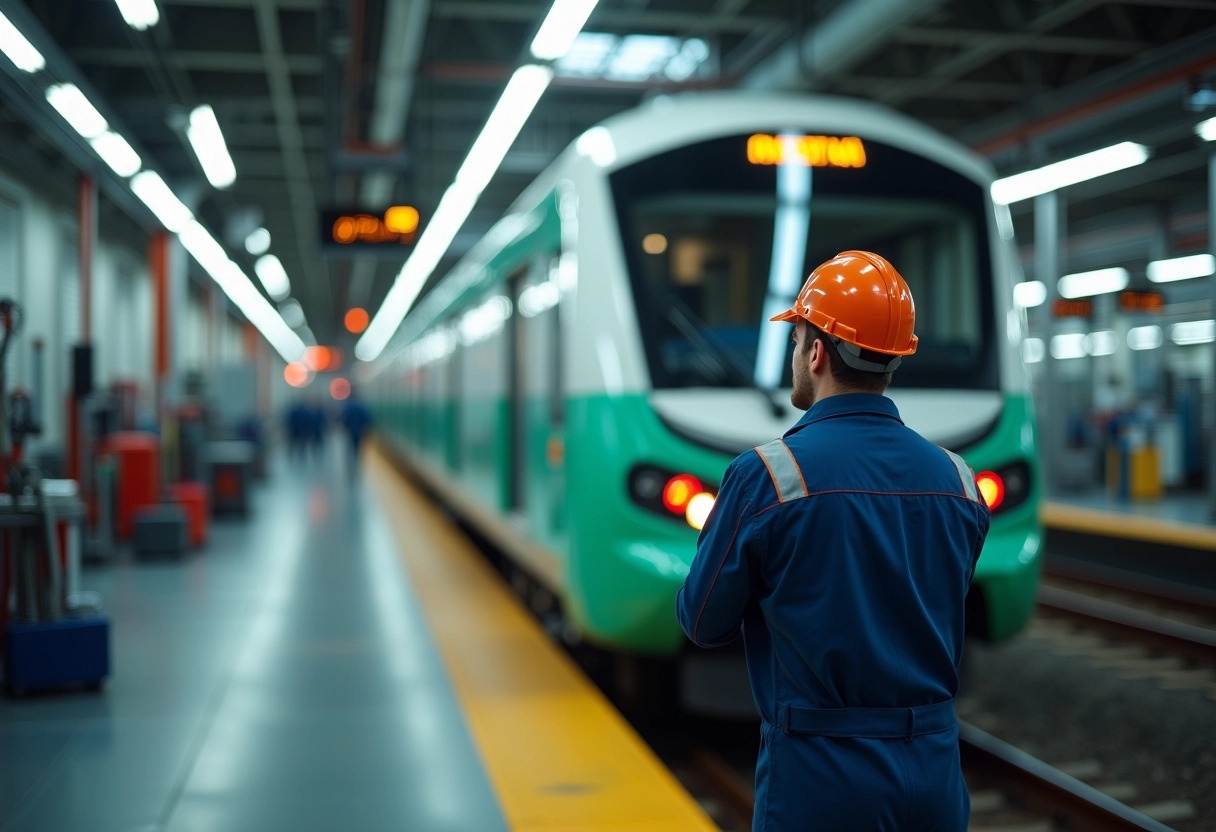
The role of rail in the energy transition
The energy transition is shaping up to be a major industrial revolution. In this context, the rail sector plays a central role due to its energy efficiency and potential for reducing greenhouse gas emissions. The rail network, by nature, consumes less fossil fuel compared to other modes of transport.
The initiatives of ADEME
ADEME, at the forefront of these issues, regularly analyzes the evolution of strategic jobs for the energy transition. It uses models like ThreeME to break down results across 37 sectors. Its projects, such as Transition(s) 2050 and SNBC 2, establish scenarios to achieve carbon neutrality by 2050.
- Transition(s) 2050: four scenarios for a carbon-neutral France.
- SNBC 2: National Low Carbon Strategy, updated in March 2020.
Impact on regions and jobs
Some regions, like Occitanie, are strongly committed to this transition. As the second French region in renewable energy production, it integrates sustainable transport into its action plan. Green jobs, related to the ecological transition, are multiplying. The rail sector, with its infrastructure and modernization projects, is a fundamental vector for this.
Rail transport is an integral part of the solutions for a successful energy transition. It contributes to the decarbonization of transport and to more sustainable mobility. New technologies, network renovation, and the engagement of local stakeholders are all levers for this transformation.